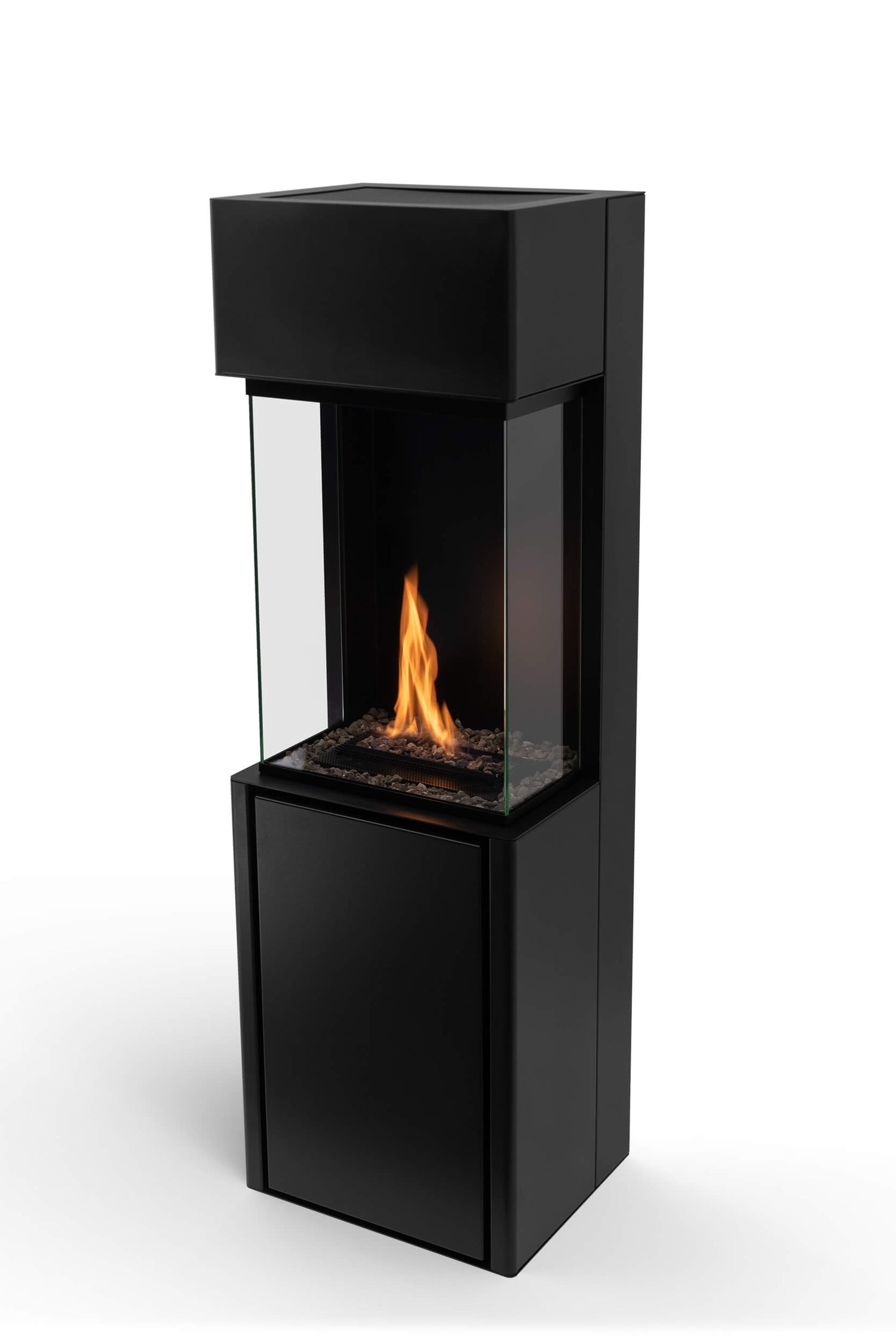

Bioethanol Burner vs Bioethanol Fireplace: What's the Difference?
When people first discover bioethanol fires, they often use the words "burner" and "fireplace" interchangeably. But they are two very different things - and choosing the wrong one for your project can mean extra cost, installation headaches, or safety concerns.
A bioethanol burner is the fire unit itself - the metal box that holds the fuel, the burner, and the controls. A bioethanol fireplace is the complete appliance - burner plus casing, glass, finished edges, and built-in safety clearances.
In this guide, we explain exactly what each option is, how they differ in installation, cost, and safety, and which is right for your home.
Quick Comparison
| Feature | Bioethanol Burner (Standalone) | Bioethanol Fireplace (Cased) |
|---|---|---|
| What it is | Fire unit only - burner, tank, controls | Complete appliance - burner inside, engineered casing |
| Installation | Custom opening, clearances managed by installer | Zero clearance - standard timber and plasterboard |
| Cost (unit) | Lower upfront | Higher upfront |
| Cost (total project) | Often higher - custom surround + specialist labour | More predictable - everything included |
| Safety | Good - but depends on installer expertise | Excellent - engineered casing manages heat and clearances |
| TV above | Possible - but requires careful planning | Yes - built-in clearances and heat deflection |
| Flexibility | High - custom designs possible | Moderate - pre-engineered configurations |
| Best for | Custom builds, specialists, bespoke designs | Media walls, standard installations, most homes |
What Is a Bioethanol Burner?
A bioethanol burner is the heart of the system - a metal unit containing the fuel tank, the vapour burner, and the control electronics. Planika's automatic burners use BEV Technology (Burning Ethanol Vapours) where bioethanol is heated to create vapour, which is then ignited to produce clean, controlled flames.
When you buy a standalone bioethanol burner, you get the fire unit and nothing else. It is designed to be built into a custom opening in your wall, media wall, or fireplace surround. Your builder or installer must create the opening, manage clearances to combustible materials, and often build a custom frame or surround to finish the installation.
Planika Burner Options (Standalone)
Planika Neo 1000: The Entry-Level Bioethanol Burner
The Planika Neo 1000 is the most accessible way to get a real bioethanol fire. It offers two flame stages, simple manual or basic automatic operation, and a compact 1000mm width.
- Tank: 2.9 litres
- Burn time: Maximum 4 hours
- Heat output: Up to5.9kW
- Flame stages: 2
- Width: 1000mm
- Weight: 18.5kg
- Price: £2,975.40*
What you get: A genuine automatic bioethanol fire at the lowest entry price. The Neo 1000 is ideal for smaller media walls and simpler installations where budget is the main consideration. It does not have Wi-Fi or app control - operation is via a simple remote or manual buttons.
Planika Primefire 990: Core Range Bioethanol Burner
The Planika Primefire 990 is Planika's core-range automatic bioethanol burner. It adds three flame stages, better fuel efficiency, and more refined control than the Neo.
- Tank: 5.5 litres
- Burn time: Up to 8 hours
- Heat output: Maximum 7.0kW
- Flame stages: 3
- Width: 990mm
- Weight: 27.5kg
- Price: £4,163.40*
What you get: A significant step up from the Neo. The Primefire 990 offers longer burn time (up to 8 hours vs 4), higher heat output, and more flame adjustability. It is the cost effective choice for many residential installations - powerful enough to heat a living room, but not as expensive as the FLA4 range.
Planika FLA4 990: Premium Automatic Bioethanol Burner
The Planika FLA4 990 is Planika's premium automatic bioethanol burner. It offers six flame stages, Wi-Fi connectivity, and app control via the Planika Firelink app.
- Tank: 5.5 litres
- Burn time: Up to 8 hours
- Heat output: Maximum 7.0kW
- Flame stages: 6
- Width: 990mm
- Weight: 27.5kg
- Price: £6,199.20*
What you get: Maximum control and convenience. The FLA4 990 lets you adjust the flame across six levels from your phone, set the room temperature, and manage the fire remotely. The 6-stage adjustment means you can fine-tune the heat and ambience precisely.
Planika FLA4+ 990: Extended Tank Premium Bioethanol Burner
The Planika FLA4+ 990 is identical to the FLA4 990 in features and control - but with a tank over three times larger.
- Tank: 17.2 litres
- Burn time: Up to 26 hours
- Heat output: Maximum 7.0kW
- Flame stages: 6
- Width: 990mm
- Weight: 38.5kg
- Price: £7,365.60*
What you get: The same premium features as the FLA4 990, but with up to 26 hours of continuous burn time. For daily use, the FLA4+ means refuelling once every few days instead of every evening. Perfect for commercial projects.
* Longest burn time based on Planika Fanola Bioethanol Fuel at lowest flame setting. Actual burn time varies with flame height.
What Is a Bioethanol Fireplace?
A bioethanol fireplace is the complete appliance - the burner installed inside an engineered casing with finished edges and built-in safety clearances. You do not need to build a surround or manage clearances yourself. The fireplace arrives as a finished unit ready to fix into your wall opening.
Planika's bioethanol fireplaces fall into two categories: the entry-level Neo Fireplace and the Forma range (a casing system designed to house either the PrimeFire 2.0,the FLA4 or the FLA4 Plus bioethanol burners).
Planika Neo Fireplace 1000: Plug-and-Play Bioethanol Fireplace
The Planika Neo Fireplace 1000 is a complete, self-contained bioethanol fireplace. Unlike the standalone Neo burner, the Neo Fireplace includes the casing.
- Dimensions: 1000 × 450 × 350mm (W×H×D)
- Heat output: Maximum 5.9kW
- Tank: 2.9 litres
- Burn time: Up to 4 hours
- Weight: 35.0kg
- Price: £3,335.40*
What you get: Very similar to the Forma casing, it needs to be built into a opening in the wall and connected to an electrical power source. It can be built into a media wall or used to create a fireplace in a traditional chimney/fake chimney setting. Shorter burn times than the FLA4 and PrimeFire.
Planika Forma: Zero-Clearance Bioethanol Fireplace System
The Planika Forma range is a modular casing system designed to house the PrimeFire 2.0, FLA4, and FLA4 Plus. The key advantage is zero clearance to combustibles - the casing is engineered to contain the heat, deflect it safely, and prevent surrounding wall materials from getting too hot.
This means your builder can use standard timber framing and plasterboard right up to the unit edges. No fire-rated materials required. No complex heat calculations. And critically you can mount a TV above your bioethanol fireplace with confidence.
Planika Forma 1200 with PrimeFire 2.0 990
The Planika Forma 1200 with Primefire 990 brings Planika's bioethanol burner into a zero-clearance casing designed for modern media walls.
- Casing width: 1200mm
- Burner: Planika PrimeFire 2.0 990 mm
- Heat output: Up to 7.0kW
- Burn time: Maximum 8 hours
- Flame stages: 3
- Price: £5,594.40*
What you get: A complete media wall solution with the reassurance of zero clearance. The 1200mm casing fits most standard UK media wall openings, and the PrimeFire 2.0 990 mm burner provides up to 8-hours of burn time with refined 3-stage control. 2-year manufacturer's warranty.
Planika Forma 1200 with FLA4 990
The Planika Forma 1200 with FLA4 990 adds premium adjustability to the zero-clearance Forma casing.
- Casing width: 1200mm
- Burner: Planika FLA4 990
- Heat output: Up to 7.0kW
- Burn time: Maximum 8 hours
- Flame stages: 6
- Price: £7,635.60*
What you get: The most adjustable media wall bioethanol fireplace. Six flame stages, Wi-Fi control via the Planika app, and the reassurance of a zero-clearance casing. The Forma casing includes built-in heat deflection to protect your TV and wall. 5-year manufacturer's warranty.
Planika Forma 1200 with FLA4+ 990
The Planika Forma 1200 with FLA4+ 990 combines the extended tank with the premium casing.
- Casing width: 1200mm
- Burner: Planika FLA4+ 990
- Heat output: Up to 7.0kW
- Burn time: Maximum 26 hours
- Flame stages: 6
- Price: £8,791.20*
What you get: Maximum convenience for daily use. The 26-hour tank means refuelling every few days rather than every evening. Combined with the zero-clearance Forma casing, this is the ultimate set-and-forget bioethanol fireplace for regular use. Recommended for commercial projects to reduce staff involvement with refilling. 5-year manufacturer's warranty.
Planika Forma Configurations
One major advantage of the Planika Forma system is flexibility in how the fire displays:
- Single-Sided bioethanol fireplace: Against a wall, viewed from the front only. Most common for media walls.
- Three-Sided bioethanol fireplace: The fire is open to the front and both ends - ideal to give the appearance of a longer burner where room size precludes a longer fire.
- Tunnel bioethanol fireplace: See-through both sides of a partition wall. Can be used as a link between 2 rooms or as a standalone fireplace in the middle of a big room.
- Room Divider bioethanol fireplace: Double-sided. Projects into the room from a side wall.
- Island bioethanol fireplace: Freestanding, visible from all four sides. Stunning centrepiece.
- Right Corner bioethanol fireplace: Fits neatly into right-hand corners.
- Left Corner bioethanol fireplace: Fits neatly into left-hand corners.
Head-to-Head: The Key Differences
1. Installation
Bioethanol burner (standalone): You need a custom opening built to the exact dimensions of the burner, plus clearances above, below, and to the sides. The opening must be finished with non-combustible materials within the clearance zones. Your builder or fireplace specialist must understand heat management. If you want a TV above, you must calculate clearances and install heat deflectors yourself.
Bioethanol fireplace (cased): The casing defines the opening. You build a simple rectangular hole to the casing dimensions. The casing includes built-in clearances - your builder can use standard timber and plasterboard right up to the edges. TV mounting clearances are specified in the manual. Installation is straightforward for any competent builder.
2. Cost
Bioethanol burner (standalone): Lower upfront cost - you are buying only the fire unit. But the total project cost often surprises people. You need to budget for: custom surround materials (stone, metal, or timber cladding), heat-resistant backing boards, potential specialist labour and, depending on the setting, glass surround. For a high-end finish, the total can exceed a cased fireplace.
Bioethanol fireplace (cased): Higher upfront cost - you are buying the complete appliance. But the total project cost is more predictable. The casing, glass, and finished edges are included. Your builder's job is simpler. There are no hidden costs for heat management materials.
3. Safety
Bioethanol burner (standalone): Safe when installed correctly. The burner itself includes safety features - automatic shut-off, CO₂ sensors, and child locks on Planika models. But the installation safety depends on your builder. If clearances are wrong or combustible materials are too close, there is a risk. The glass surround, if required, must be specified and installed correctly.
Bioethanol fireplace (cased): Safer by design. The casing is engineered to contain and deflect heat. The glass front is integral - not an add-on. Clearances are built in, not calculated. Planika Forma casings are tested and certified for zero-clearance installation. For homes with children, pets, or where you want absolute confidence, a cased fireplace is the safer choice. Plus all the features of the Planika burner.
4. Flexibility and Design
Bioethanol burner (standalone): Maximum design freedom. You can build any surround you like - marble, concrete, steel, or timber (outside clearance zones). The burner is invisible until the fire is on. For architects, interior designers, and bespoke projects, a standalone burner offers unlimited creative possibilities.
Bioethanol fireplace (cased): slightly less design freedom but guaranteed results. The casing defines the look. Planika Forma offers clean, modern lines in black or white. You can add your own mantel or surround outside the casing edges, but the fire unit itself has a fixed appearance. For most homeowners, this is a benefit - you know exactly what you are getting and know that your fireplace is completely safe.
5. TV Mounting
Bioethanol burner (standalone): Possible, but demanding. You must maintain clearances specified by Planika (typically 750–900mm from the top of the burner to the bottom of the TV, depending on TV size and heat tolerance). You need to install heat deflectors and ensure adequate airflow. Many installers recommend against TVs above standalone burners unless the project is managed by a specialist.
Bioethanol fireplace (cased): Designed for it. Planika Forma casings include a heat deflector which can be added to the inside top of the unit. The casing channels heat forward into the room, not upward toward the TV. Planika specifies exact TV mounting distances for each Forma model. For media walls, a cased fireplace is the safer, simpler choice.
Which Is Right for You?
Choose a Standalone Bioethanol Burner If:
- You are working with a fireplace specialist or architect who understands heat management. Talk to us before you design your fireplace.
- You want a completely bespoke surround - marble, concrete, or custom metalwork
- You have a non-standard opening or an existing fireplace to retrofit
- You are confident managing clearances and TV mounting distances yourself
- Budget for the fire unit is tight, and you are prepared for higher installation costs
Choose a Cased Bioethanol Fireplace If:
- You are building a media wall and want to mount a TV above the fire
- You want a straightforward installation that any competent builder can handle
- Safety and peace of mind are priorities - zero clearance means no guesswork
- You want a predictable total project cost with no hidden surprises
- You prefer a finished, guaranteed look rather than a custom build
Running Costs
Whether you choose a standalone burner or a cased fireplace, the running costs are the same - they use the same burners and the same fuel.
Fuel consumption based on Planika Fanola Bioethanol Fuel at £4.00/litre:
- Planika Neo 1000: ~0.7L/hour - approximately £2.80/hour
- Planika Primefire 990 / FLA4 990: ~0.75L/hour - approximately £3.00/hour
- Planika FLA4+ 990: Same consumption, but 26-hour tank
Frequently Asked Questions
A bioethanol burner is the fire unit itself - a metal box containing the fuel tank, burner, and control system. A bioethanol fireplace is the complete unit, including the burner inside a casing (like Planika Forma), finished edges, and often a partial glass front. Burners are built into custom openings; fireplaces are ready to install as complete appliances.
A standalone bioethanol burner requires careful planning. You need a custom opening, proper clearances to combustibles, and ventilation. A cased bioethanol fireplace (like Planika Forma) is far simpler - it is designed as a zero-clearance unit that a builder can install using standard timber and plasterboard.
A standalone burner is cheaper to buy, but the total project cost is often higher once you factor in building a custom surround, managing clearances, and specialist labour. A cased fireplace costs more upfront but includes everything - casing, glass, finished edges, and built-in safety clearances - making the total installed cost more predictable.
It can be. A cased bioethanol fireplace (like Planika Forma or Neo Fireplace) has the burner enclosed within an engineered casing that manages heat, includes safety glass, and maintains proper clearances automatically. A standalone burner leaves these responsibilities to the installer. Both use the same safe Planika BEV Technology, but the casing adds a layer of protection.
Using a cased bioethanol fireplace like Planika Forma, it's relatively easy to install a TV above your fireplace. The casing includes a heat deflector and specified clearances for TV mounting. With a standalone burner, you must calculate and manage clearances yourself, which is riskier and often requires a specialist.
No. Neither requires a chimney, flue, or ventilation system. Planika bioethanol burners and fireplaces are completely flueless. They produce minimal water vapour and carbon dioxide during clean combustion. However, minimum room sizes for each fire must be observed.
Choose your burner based on your room size and media wall opening width. For a 1200mm wall opening, a Planika PrimeFire 990 or FLA4 990 fits well. For larger openings (1500mm+), consider FLA4 1190 or 1490. For very large feature walls, FLA4 1990 or 2490 provide dramatic wide flames.
BEV stands for Burning Ethanol Vapours. Used in Planika automatic bioethanol burners, the fuel is heated to create vapour, which is then ignited. This produces clean, controlled flames with no smoke, no ash, and no need for a chimney. It has the added safety advantage of the flame never coming into contact with the main reservoir of bioethanol fuel.
Should I consult an expert before deciding which fire to buy?
Ideally, yes. By talking to us first, you can make sure that you buy the right fire for your project. We'll talk you through the options and can advise on materials and installation. Our goal isn't just to sell you a bioethanol fire, it's to make sure that you buy the right fire and install it safely.
About the Author
This guide was written by John Rogers, our in-house bioethanol fire specialist with 20+ years of experience working with Planika and EcoSmart systems across the UK. John has completed 1000+ installations and personally reviews every piece of technical content on our site.
Explore the Ranges
Standalone Bioethanol Burners
- Planika Neo 1000 - Entry-level, 2 stages, max 4-hour burn
- Planika Primefire 990 - Core range, 3 stages, max 8-hour burn
- Planika FLA4 990 - Premium, 6 stages, Wi-Fi, max 8-hour burn
- Planika FLA4+ 990 - Extended tank, max 26-hour burn
- All Planika FLA4 Burners - Full range from 590mm to 2490mm
Cased Bioethanol Fireplaces
- Planika Neo Fireplace
- Planika Forma Range - Zero-clearance casings from 800mm to 2700mm
- Planika Forma Single-Sided - Standard media wall choice
- Planika Forma Three-Sided - Peninsula installation
- Planika Forma Tunnel - See-through room divider
- Planika Forma Room Divider - Double-sided freestanding
- Planika Forma Island - Visible from all sides
- Planika Forma Right Corner - Corner fitting
- Planika Forma Left Corner - Corner fitting
Related Reading
- What Is Bioethanol Fuel? Complete Guide
- Planika FLA4 vs FLA4+ vs Primefire: Which Should You Choose?
- Water Vapour vs Bioethanol Fireplace: What's the Difference?
Need Help Choosing?
Speak to our specialist John Rogers for personalised advice on whether a standalone burner or cased fireplace is right for your project.
Meet John Rogers or contact us for expert guidance.
---
Last Updated: June 6, 2026
Prices and specifications correct at time of writing. Running costs based on Planika Fanola bioethanol fuel at £4.00/litre. Always follow Planika's installation manual for clearance requirements.

